
Interview with Cryptic Shift
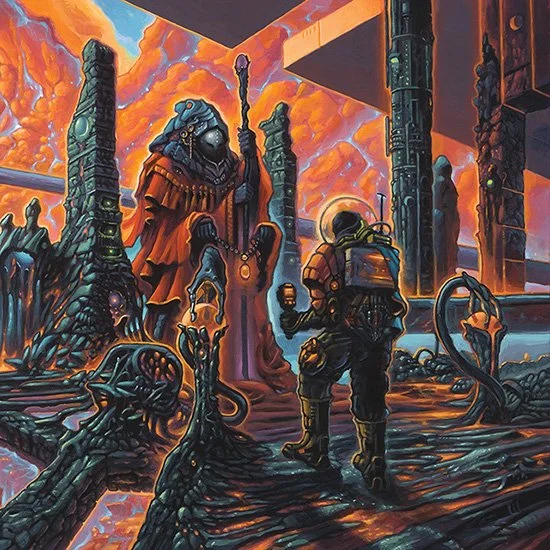
Cryptic Shift are an extreme metal band from Leeds, UK. Their recent album “Overspace and Supertime” released on the 27th of February. I got the chance to interview Xander [Lead singer and guitarist] and Ryan [Drums].
I had a great time listening to their album, and immediately fell in love with their sci fi concept. The boys were so sweet to talk to and clearly have a lot of love and care for their work.
INTERVIEW HERE
Elisha: How are you feeling?
Cryptic Shift: Yeah, we’re good. How are you?
Elisha: I’m fab, thank you. Let’s get started. So, first of all, let’s talk about the new album. How do you feel that it’s coming out shortly?
Ryan: Yeah, it’s good. I’m pretty excited. It’s been a long time since we’ve put an album out, so it’s always fun.
Xander: We spent a lot of time writing it. We finished writing it about a year ago and then we went through the whole recording process, so it’s been a long time since it’s been complete in our minds, but it’s nice that it’s coming out.
Elisha: Yeah, I’m excited and I’ve given it a listen. Obviously, you say it’s sort of a parallel to your first album, which you can definitely hear. It’s a bit uncanny valley in the best way.
Cryptic Shift: Yeah, I get what you mean.
Elisha: It’s really interesting to listen to. What was it that gave you the concept for that? Does it come from something or was it just an idea?
Ryan: I guess the concept idea started years ago. Probably, I don’t know, 2018 or something.
Xander: Well, probably way before that. Probably 2016? 2017?
Ryan: It was just a fun thing to do for the first album when that came around, but now we’re at the point where we’re actually consciously working on it. The first album was such an open book, so for this album, it was like we’re going to have to add on to what we’ve already done.
Xander: We could have made the decision to do a completely different story, but Xander could probably tell you more about why we chose to stick with it.
Ryan: We were quite into a bunch of film franchises, where every entry expands on the lore, so it made sense for us to take that formula and continue it.
At the end of the single, Cosmic Dreams, the character gets split into two personalities – two different entities – and Visitations [from Enceladus] is with the first one.
The second album was always going to be what’s going on with the other character. It was planned – with the risk that we’d left it open – to bring them back to show a different viewpoint of the same event.
Elisha: Wow, that’s so interesting. That actually really leads on to my next question, which is: what were the sci-fi influences? What films and TV shows were the main things that brought the album to life?
Xander: It’s always going to be the Star Wars prequels, first and foremost. Those are our foundational sci-fi movie experiences with me and Ryan growing up being proper into the prequels and seeing them in cinemas.
Ryan: I think if someone says, ‘imagine a futuristic human race in another galaxy’, I’d be like ‘yeah, that’s The Phantom Menace, I’ve seen it’, so like Xander says, that’s the main frame of reference. But then we’re not necessarily super sci-fi nerds, so it’s kind of all the basic stuff.
Xander: When we’re writing the album, our head space is in there and we’re all putting in a reference to whatever and influenced by this, but it’s been over a year since we’ve finished it. Those kinds of things go out of your mind because you’ve put it all into the record. You can let it live now. But, yeah, it’s always Star Wars first. I guess Alien – being in the Nostromo – and H. R. Giger’s weird take on dark sci-fi corridors is always a big inspiration because we go back to the Moon Base in Hexagonal Eyes. That dark, dead space visual was a big thing for that.
Ryan: Video games as well – especially the ones where they’re a bigger open world. Whether that’s Mass Effect or the early Star Wars: Knights of the Old Republic and then even No Man’s Sky. That’s a cool inspiration because, again, they’re taking the whole idea that space is limitless.
Xander: A couple of other video games are all the Lovecraft inspired ones. The eldritch gods that inhabit the world, despite us not being able to see them, and that idea of inventing a pantheon of deities that get referenced in our story. And then on Visitations, the third Borderlands game. That was all set in space, so that was a cool inspiration for Moonbelt [Immolater]. But for this album, we’re inside this Moon Base, so we don’t really go outside onto the surface of that moon on this one.
Elisha: Hmm, interesting. I actually do sci-fi; it’s one of my modules that I do in university, and we talk a lot about the real-world applications. Obviously, most sci-fis are some sort of allegory for something or meant to show – a bit like Black Mirror or 1984 – what the world could be like if we don’t do something about it. What would you say your real-world applications were for the album, if you have any?
Xander: I’d say that we are literally just full of love for sci-fi, really. The reason we enjoy sci-fi is because of the cool aliens and the battles and whatever, but I think the reason we stay and watch those movies again is because there is some foundational thing to them. Cryptic is taking that same sort of approach.
There’s a bunch of references in the lyrics that maybe hint at philosophical ideas and things like that, but it’s embedded. We don’t want to push that as a political message; it’s all about the enjoyment.
Ryan: Through studying sci-fi, you might know that a lot of the concepts come through interpretation. That’s another great thing about sci-fi: pondering the meaning of things, even though you come to find out it was never intended in the first place.
Like Xander says, there’s maybe some sort of philosophical influence in there, but it’s all subconscious, so if someone else picks up on that, that’s pretty cool.
Elisha: Yeah, absolutely. The whole point of storytelling and fiction is to be able to see yourself in a story and connect to it. Can you talk to me about how you navigate the storytelling aspects? I did notice in your opening song there was a section that was meant to sound like a helicopter and it was just the guitar. I don’t know if that was the point, but I thought that was really interesting instead of maybe just putting a helicopter noise in there.
Xander: Yeah, I think you mean a minute or so into the opening track: Cryogenically Frozen. That’s the character – the Recaller – crashing her ship onto some planet and, yeah, I guess it does sound a bit like a helicopter where it chugs a bit and then echoes out.
Ryan: That’s one way storytelling is portrayed: through music, so I guess that’s achieved its sonic purpose there. Also, in that part there – or just before it – there’s some samples with spoken word. That’s not necessarily something we rely on too much, but that’s at least one way we can get in some sort of narrative.
Xander: Yeah, to have the album open with – like how sometimes movies open with a little voiceover or some text comes up – it was kind of like that to introduce the album and give a premise. It’s meant to be a ship with a bunch of humans on, exploring some planet and then seeing the Recaller coming out of a wormhole and seeing her crash onto the planet.
All the voiceovers at the start are like the bridge communication chatter over the radio waves: ‘There’s a ship that’s appeared.’ ‘It’s going to crash into the planet.’ ‘We need to send a team to rescue her.’ And then she gets put into cryo-freeze.
Ryan: I guess lyrics are quite narrative anyway in their nature, so they’re pretty straightforward.
Xander: You can look at the lyric and deduce a visual of what’s going on. It’s not as straightforward as ‘the ship crashed into the planet’; there’s often scientific terminology thrown in there to create a visual of what’s going on. And your own mind can create imaginings of what’s going on.
Elisha: Yeah, that’s what I was about to ask. When you went into writing the album, did you expect people to see in their minds when they were listening to it what you’ve put out as the complete story, or were you expecting a lot of their own interpretations, or maybe even their own stories coming out of it?
Xander: When I’m playing the album in the practice room, I imagine all of the visuals in my own head, and I’m happy that the lyrics have got to the fans in a way that they take it as seriously as the music, because that’s what we’re trying to push. There’s been fans that bring full print-out lyric sheets of songs and follow along with us live because they like following the story.
Elisha: Amazing. What’s next for you, then? Are we thinking a tour? Are we thinking maybe some more merchandise? A comic series? Anything like that?
Ryan: A comic-book series would be cool, but right now, it’s just arranging touring for the rest of the year in support of the album, and merchandise will come with that. But we’re not done yet with the album. We’re going to work on a couple more music videos and stuff like that, so that’s our priority for the rest of the year. And then we’ll be working on new material.
Xander: Yeah, the whole comic-book angle would be really cool. I think there’s a lot of things we could do there given the story and visuals we have. But obviously, it’ s got to sell records so we can have money to put behind stuff like that. Getting a whole comic-book of original commissioned art is like the cover art for the album times a hundred.
Ryan: We could draw it, but it would look atrocious.
Xander: It would be cool to do stuff like that, but we’ll see what happens.
Elisha: Yeah, I’ll definitely be looking out for it. Have you got anything to add before the end?
Ryan: Just cheers for checking out the album, and if you’ve not checked it out, check it out. Try and imagine what’s going on, have a cool time, and enjoy it. The album’s supposed to be devoured in on whole setting, so strap in for the journey.
Xander: And thanks for focusing on the lyrics and story and stuff.
Elisha: I love this sort of thing; it’s really great what you do. And I know you say you didn’t have a political objective in mind, but I think focusing on stuff like sci-fi and storytelling and original concepts in your music is enough.
Xander: When it comes to being in a sci-fi band, we’re not just playing regular death metal and having sci-fi lyrics. We try and go full in on everything, making our music sound sci-fi.
Ryan: It’s the recognition of the overall art form, as well as being an extreme metal band.
Xander: And having metal fans and sci-fi fans. It’s really cool to bring them together.